The first question asked is always the same: what’s it about? Fair enough, I suppose, but then I’m only the author. This, however, was the one that dogged me all the while I was promoting my first novel, The Long Drawn Aisle – to friends, strangers, and the many independent bookshops of London in the winter of 2015. I certainly had a good go at formulating an answer. Indeed, I had tried many a time throughout the course of writing and editing. But whenever I finally settled on one, another immediately surfaced to lay a greater claim to what it was actually about. That, perhaps, is the problem when one structures a novel around themes: plot is so much more categorical. The basic outline of a plot is generally straightforward: this happens, and then this happens, leading to such and such and – well, in due course, the end, by whatever byway or backway. Virginia Woolf (and others) considered this to be the ‘tyranny of plot’; the tyranny of ‘then’.
What happens in between these ‘thens’ is the essence of a novel though. Or it ought to be. These are the bits which float between the action; between what is done. They are the whys. They are everything to do with what a character thinks as he or she does something; and why – and why not – they speak certain words, about certain things, in certain ways. Behind these lie reasons which do not ‘stand on consistently firm, secure ground, but passes over holes…it ceases to exist for a moment,’ as Robert Musil observed in The Confusions of Young Törless. They are everything that the author might hope to convey by the finest of brush strokes, but which, persuaded as he inevitably is to the exigencies of the next paragraph or scene, he is nonetheless constrained by due to the intangible convolutions of the individual character’s mind. After all, the author should never have complete mastery over their characters if he allows them to think and act freely. He cannot dictate with precision how so and so truly thinks. To massage another line from Virginia Woolf:
“One can only give the audience the chance of drawing their own conclusion as they observe the limitations, the prejudices, the idiosyncracies of the speaker.”
So, never quite succeeding in being categorical about what The Long Drawn Aisle was about in a pithy ‘then and then’ pitch, I determined to have one for the sequel, which I immediately set about writing.
The plot would be the plot to assassinate the Austrian Emperor at the end of the first world war. A plot mined from the truth – though it was never clear what was true. So – Bang! A hook in a line! The blurb at the back! But that framing device cannot possibly detail what the book is about; what fills the holes between words; where it began.
So it began with two film scripts languishing in a drawer in 2002. The next effort would have to be printable, provable. A Master’s degree in Imperial history was begun, and soon a vague idea of a WW1 novel based on a disfigured soldier was crystallised by politics into something far broader.
Of the many antecedents to the conflict the campaign for Tariff Reform, launched in 1903 by Joseph Chamberlain and then soundly defeated at the polls three years later, might seem one of the most removed from the cause. It’s aim had been to reverse the system of Free Trade that had been British policy since the revocation of the Corn Laws half a century earlier. It was a policy that had enriched the nation as a whole but left many impoverished, both at home and abroad. The re-introduction of Protection would not only allow Britain to restore parity with (or retain supremacy over, depending on one’s perspective) the tariffs levelled by the other advanced industrial nations against Britain, it would cement the bonds of kinship within the Imperial family through preference. That family might be considered to include America by some; certainly not by others.
Joseph Chamberlain’s appeal was to the working man who had suffered under global Free Trade.
The opposing liberal crusade against reform was also directed at the working man: protection would lead to price of bread and other food stuffs to rise, and the working man would suffer. How, indeed, it was contended, could such a beneficient – almost godly – system of free trade, which had brought such wealth and enlightenment, and would continue to do so for as long as no one nation was favoured above another, be wrong?
In The Long Drawn Aisle Jack Wilson’s conversion to Methodism was something almost divinely ordained; free trade was the natural companion of universal peace. But what came first for him, his beliefs of his actions? Alec D’Urberville could not put one before the other. And so, after the father, what then came first, Jack Wilson’s sons’ thoughts and beliefs, or his actions? And then…and then…there is the interpolation of war.
So in The Passing Tribute life continues. One shattering empire might mirror another; or it might not. It depends on the conclusions drawn at whatever end might be reached.
For many young men the conclusion of the First World War brought profound disillusionment, as much due to the realisation that the ‘highlight’ (all the extremes of emotion imaginable) of their lives had already passed, as due to the losses suffered, physical, mental, material, and religious. And so, what then? What then to provide inspiration and purpose and not to apathetically think:
“How weary, stale, flat and unprofitable/ To me are all the uses of the world.”
In one post-war memoir the author recalls a fairytale about two countries held together by a hair, and when that broke they fled apart. Or rather, he does not recall it, for he knows no more of it than that. My own efforts to unearth it have been far from exhaustive, but I have not found it either. Perhaps, when I do, I’ll be able to succinctly explain that that is what the book is about.
This article first appeared in Portobello Book Blog in May 2019
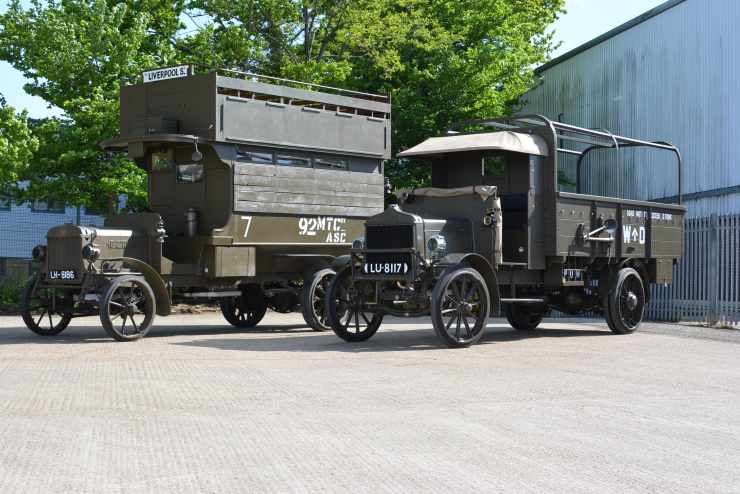
Above: The LT Museum’s B-Type bus, and an AEC Y-Type lorry, many of which were converted to London bus use in the immediate aftermath of the war owing to the decimation of the B-Type fleet on the Western Front.
 Simon Marshall